


Movement: How to Take Back Our Streets and Transform Our Lives by Thalia Verkade and Marco te Brömmelstroet
Places Discussed
- Various
Posted 2025-09-15
 Book Notes by John December
In this book, the authors reveal how transportation and land use assumptions have placed death traps, discontinuities, and dangers in neighborhoods and streets that disfavor human movement in favor of automobile flow. Ultimately, the authors show that we don't have to live this way, and that the ability to choose a different set of priorities is with us--as it always has been.
This book presents the personal journey and the story of its co-authors, the journalist Thalia Verkade from Rotterdam and Marco te Brömmelstroet, Professor in Urban Mobility Futures at the University of Amsterdam ("the cycling professor"). Their professional interaction on this topic gave rise to the first edition of this book, published in 2020 in the Netherlands as Het recht van de snelste by decorrespondent.nl, a member-funded journalism platform. It was revised for an English-reading audience and published in 2024 by Island Press.
The authors open the book with a simple statement: "This book is about our streets and why we take it for granted that they are designed first and foremost for movement from A to B, rather than incorporating other uses that could benefit our communities in different ways." (p. 1). Exploring this theme contributes to a significant rethinking of human movement, infrastructure, mobility, and transportation. They touch on many issues from other re-evaluations of transportation (Marshall 2024; Handy 2023; Peterson 2022; Marohn 2021; Norton 2021), but their close look at personal stories reveals a stark conclusion.
The authors' explorations confront a range of issues:
-
Technical models based on opaque methodologies
dictate traffic and land use decisions
and are frequently followed without question.
As the authors examine pedestrian and automobile crashes and deaths in neighborhoods, and the difficulties of people to navigate our street design, they see a pattern. Thalia states, "I'm learning just how much the logic of traffic engineering determines the way our residential areas are designed...." (p. 36). She calls the CROW traffic and facilities standards a dark "machine room" that puts public space on autopilot (p. 160).
The authors question why the Dutch methodology, DOCTOR (objective conflict technique for operation and research), reduces the analysis of people in a city to a set of conflicts, when a solution based on cooperating people (such as the chip cone intersection for interacting people and bicyclists) might be shown to work better (p. 22). The authors describe how models like DOCTOR "take precious little account of human behavior or how people respond to and interact with their surroundings. And they take no account at all of the fact that people, unlike their vehicles, are capable of making choices" (p. 55). This corresponds to Marshall's (2024) analysis of shortcomings of traffic engineering assumptions that ignore human agency.
The authors delve into elements of infrastructure formed by these technical models. For example, the placement of traffic lights--and point out that it is not just a technical matter "It's a social, political, and moral issue: a question of who has most rights" (p. 25). The authors propose a potential approach for more flexible control, involving a TCS (Traffic Control System) that utilizes sensors embedded in asphalt and incorporates computer nodes for traffic signals. This system can prioritize traffic based on various types (p. 26).
The authors examine another technical formula that "shows clearly how the asphalt machine works"--the I/C ratio. The I/C ratio, which measures traffic intensity and capacity, prescribes "perpetual road construction" (p. 53) as a solution. This vehicle-focused method leaves out alternatives "such as cycling or taking public transport, because vehicles can't make such a choice, and vehicles are the focus of the system" [not people) (p. 54). This vehicle focus erases alternatives--makes them invisible--and leads to perpetual highway and road building. (See also: Todd Litman, "Generated Traffic and Induced Travel" and Transportation for America 2020, "The Congestion Con: How more lanes and more money equals more congestion".)
Parking also involves arbitrary decisions, also driven by CROW. With the Netherlands having multiple parking spaces for every car (p. 36), CROW specifications promote high parking availability. These models silence discussion by putting the details of standards behind a paywall (p. 163). While the author observes that many cities follow CROW as if it were gospel, she points out "that's just a guideline. They aren't obliged to stick to it." (p. 41). (See also: Shoup 2005, 2011; Shoup 2018; Mepham 2024; Knowles 2023; Grabar 2023).
Finally, the authors question why these technical models are not examined more closely. She asks, "Why is it that I'd had no views at all on the design and layout of my street and my city until now? I know the answer to that one: it is because street design is viewed as a technical matter for traffic experts, rather than a political issue that concerns us all." (p. 159)
-
Embedded assumptions in language influence our perception of urban infrastructure and traffic flow.
The author observes that the pursuit of traffic circulation as the norm can eradicate the very city life it seeks to enable. The metaphor for city traffic circulation as water circulation, in Amsterdam, led to proposals to fill in canals to make streets for cars. The metaphor of water circulation led engineers to actually want to co-opt water features of the city to turn it into a stream of automobile traffic. This visualization of "traffic circulation" takes hold so strongly that "the idea that streets exist to channel motor vehicles... can now be seen in nearly every newspaper article..." (p. 70).
The (mistaken) belief in traffic as water persists in thinking that puts "free mobility for cars before the needs of pedestrians." This "converted the streets into 'vehicular space.' Even the pavements, the margins to which pedestrians were now consigned, were part of this vehicular space, following the engineers' geometric logic." (p. 90). This transformation in how we talk about the street shows how "responsibility for safety was transferred to the most vulnerable road user" (p. 90).
Shifts of language set up a car imperative. She traces how the Motorway Design Guidlines was used to define the Non-Motorway Design Guidelines reflecting "The mindset that puts efficiency and traffic flow first--which is so much in evidence in motorway design--also came to dominate the design of other traffic situations including those in ordinary residential streets" (p. 94). She observes that this shows that "a sort of template has been created, based on motorways, and it now determines the way we look at roads and streets in general....you get guidelines with terms like 'non-motorways', and we construct reality based on that" (p. 95).
The authors also explore the word "accident," and how it is used to transfer blame, erase blame, or even remove active human agency in crashes. The author states, "I learn about the inadequacy of the language we use. A crash is often called an accident--but why do we call something an accident if it is the predictable result of policy? We could also call it systemic violence" (p. 125).
In the Netherlands, an effort has been made to reverse the burden of proof for culpability from the victim of road crashes to the active agent causing the car crashes. This liability for cars holds that, "The owner of holder of a motor vehicle who drives the said vehicle or has it driven shall be liable for any damage caused..." This is "a reversal of the burden of proof. It was the opposite of the notion of jaywalking" (p. 104). This gives legal protection for pedestrians and cyclists and liability for car drivers; it is what makes the Netherlands different. The liability law holds that "the onus lay on the motorist to prove that they were not responsible." The Netherlands Supreme Court finds an automatic liability: the "motorist automatically bears 50 per cent liability....", and with crashes involving children up to age 14, the liability is automatically 100%" (p. 106).
Through introspection during her writing, Thalia questions "car ownership as the norm" (p. 73). After a time of looking at how and why her family uses a car, she observes that "The area around our homes is so unpleasant that we spend our holidays in bungalow parks to avoid being surrounded by cars... After a weekend of scattering peanuts for the squirrels at our door, we come to a decision. We don't need our own car after all." (p. 73).
Thalia examines the Dutch woonerf, or "home zone" (p. 115), the "flow street" (at 50km/h speed, allowing traffic to flow at speed and "not designed to be places where people want to spend any length of time") (p. 79), zebra crossings that are "clearer than street intersection ramps" (p. 81), MaaS = mobility as a service (p. 216) and MaaC = Mobility as a Commons (p. 217). She touches on the "hyperpoximity" efforts in Paris (p. 194) (see also Moreno 2024).
The authors examine the older definition of the word "traffic" as "interpersonal dealings" (p. 204), and this interpretation implies that the burden is on people to interact with those around them. The driver's responsibility extends beyond seeking unencumbered speed; it also involves focusing on the other people in the environment, including drivers, not just the vehicles (p. 226).
Marco and researchers look at traveling as a flow. They challenge the dominant view that travel's purpose is only a derived activity (to go from A to B) and that travel time is a disutility. Marco's published paper on this is: Have a good trip! expanding our concepts of the quality of everyday travelling with flow theory. Applied Mobilities, 7(4), 352–373. https://doi.org/10.1080/23800127.2021.1912947)
-
Automobile organizations subsumed groups focused on children and pedestrians to form an overarching organization focused on an agenda for automobile dominance.
A surprising and intricate (to the point of confusion) series of organizational name changes led to a consolidation of interests in safety. One organization adopted the shocking name, "Stop Murdering Children," which advocated for the safety of children in neighborhoods and streets. This organization changed its name to "Priority for Children!" but then was swallowed up by "Traffic Safety Netherlands," which subsumed the interests of protecting children to shift culpability away from automobile drivers and placing the onus for safety on vulnerable road users. This shows "how a pressure group can be sidelined by the established order" (p. 154). This absorption was enforced by a threat of loss of funding--"Priority for Children!" and the "Pedestrians' Association" had to merge with Traffic Safety Netherlands or lose their national subsidies (p. 155). There were more mergers and name changes, too hard to follow (which was perhaps the entire intent of these mergers), which eventually resulted in Traffic Safety Netherlands forming the official face of safety for the country, all the while placing the burden on and blaming vulnerable road users for crashes and deaths.
The Dutch Cyclists' Union managed to stay out of these mergers and is now the "world's biggest and most influential cycling association" (p. 100). The author states, "This is why I'd never realized that there was any other way of thinking about traffic safety. The alternative organisations that could have pointed out a different path had been devoured by the monolith" (p. 159).
-
People interact and react to the transportation choices and infrastructure presented to them in predictable patterns.
The authors examine observations that, over time, are so consistent they are sometimes taken as "laws" or "constants."
The travel time budget, sometimes called Marchetti's constant has been observed to exist, showing that people use, approximately, around 70 to 80 minutes a day for travel time in total, no matter what modes they use.
This observation of "constant travel time and trip rates" (p. 44) explains quite a few aspects of our landscape. If people need to travel long distances, they will have to travel more quickly. And the converse is true: "Give people speedier transport, and they won't use it to spend less time traveling, but to move further afield" (p. 48). This influences the fixation on speed alone as the ultimate in mobility (p. 51) for sprawling urban areas.
Another observation is that the "fundamental law of road congestion" states, "Asphalt has been shown to attract cars: you can't get rid of congestion by building more roads" (p. 47). This corresponds to induced traffic (Todd Litman, "Generated Traffic and Induced Travel") and inspires the "black hole of congestion" diagram (p. 58):
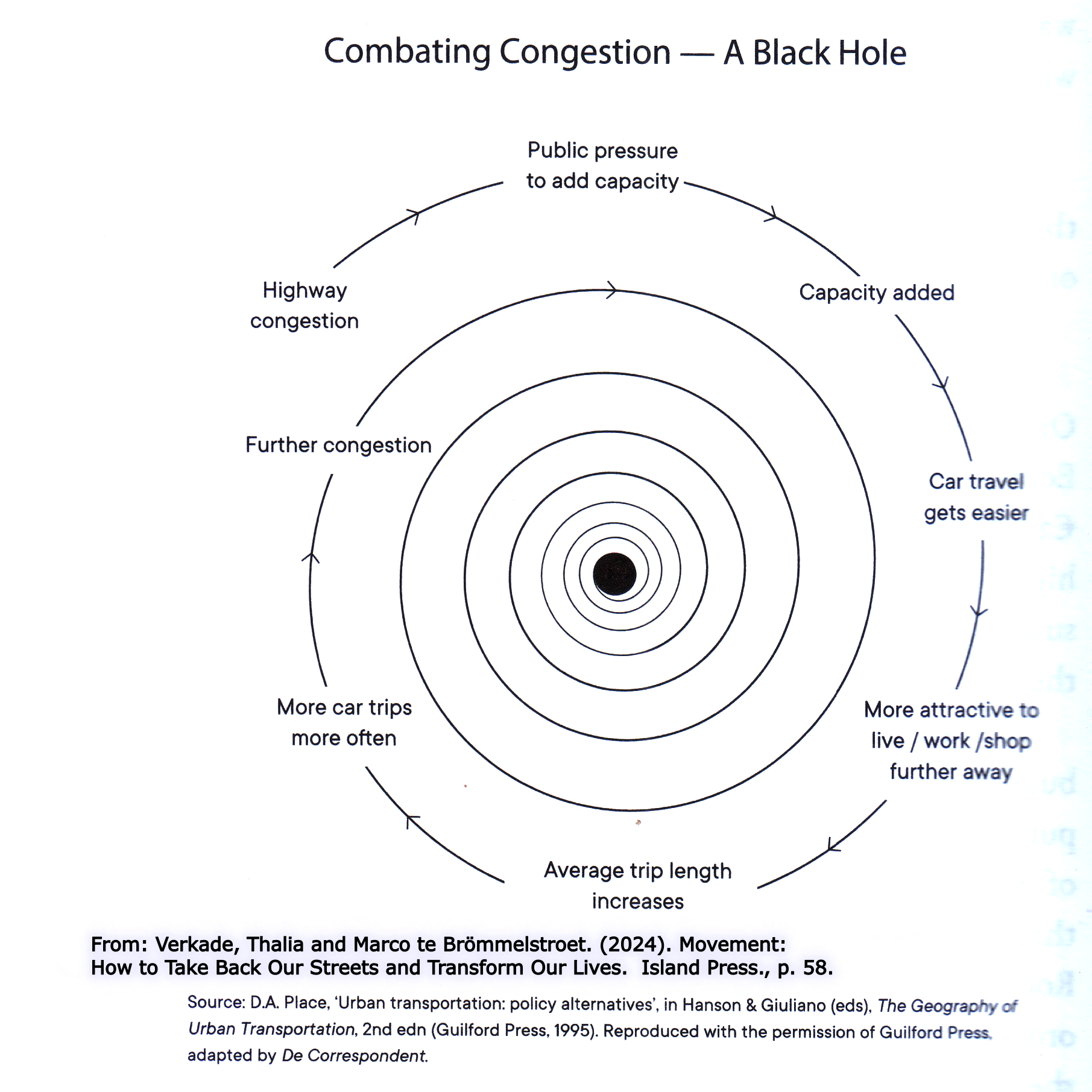
Source: Verkade, Thalia and Marco te Brömmelstroet. (2024). Movement: How to Take Back Our Streets and Transform Our Lives. Island Press., p. 58.Observations about the demand for goods and monopolies on supply also apply. The concept of "the radical monopoly" suggests that one product dominates the market, pushing out all others to the point where it supplies nearly all needs. The authors apply this to car dependence and state, "In everyday language, that means that we allow everything in our lives to depend on cars, even if we destroy each other in the process. It also means that we can't escape from such dependence" (p. 131). Thalia observes that "Cars' radical monopoly has also affected the way we report traffic accidents" (p. 132). She observes that, "our status quo also represents a choice... What we have now seems like such a natural state of affairs. It's only after quite a while that it dawns on me why I can't work out how we might change the existing situation... space and traffic are interlinked" (p. 66).
-
The emotional heart and impact of the authors' realizations come to a stunning conclusion.
The reason why the co-author, Marco, wanted to collaborate with Thalia was to eventually turn the discussion into a highly personal issue of grief and guilt (p. 123). As a child playing with friends, Marco witnessed his friend Dion's death in a traffic crash. After Dion jumped out from a hedge near a road, a car driver killed Dion. Thalia states, "I learn how deep the trauma caused by traffic violence is and how far it extends" (p. 125). Marco, ruminating on this unspoken horror and grief, went on into adulthood advocating for vulnerable road users (p. 243). The extent of car harm (Miner, et al, 2024) is incalculable. As a weekly average, 430 Europeans die in crashes, "... and for many of those affected it's impossible to come to terms with" (p. 125) and "more Americans have died in car accidents in the past 20 years than in both [20th century] world wars... it is the main cause of death among the young (15-29)" (p. 125).
External human injury costs accumulate, but "traffic engineers won't count your problems as part of the cost of car use" (p. 159). The bill can be calculated--about 21 B Euros "goes unpaid every year... Those costs are passed on to taxpayers, accident victims, and people with traffic-related health problems." The "perverse" economic benefit is that injured people require extensive medical care, and this care generates employment and economic output (p. 159).
The authors established the Web site, roaddanger.org to collect news items about traffic crashes. Their effort is the "atomization of the news," aiming to get at the individual, local, often underreported tragedy of the daily and hourly death toll (p. 135). Their work enables people to experiment with headline changes that reflect the chapter title of their book, "The Story That's Never Told."
Their work challenges the mindset that "It's up to victims to take action to avoid becoming victims" (p. 140). The irony is that this mindset runs very, very deep. The author observes that "The National Organisation for Traffic Victims... would meet in Middleburg on the World Day of Remembrance for Traffic Victims -- in a hotel that's hard to get to except by car" (p. 128). At this Remembrance, Thalia witnesses "a mother unconsciously blaming her son for his death by urging other young people to be more careful.... I bite my tongue. It feels as if these victims have been punished twice: first by the tragedy itself, then by the way society talks about it, putting the onus on vulnerable road-users to be more careful. This mother really is saving children's lives--it may genuinely help if people remain alert ... But why has no one here said it's insane that it is so easy to die in the streets around your own home..." (p. 129).
Thalia refers to Charle's Marohn's Confessions of a Recovering Engineer (p. 164) to understand how traffic engineering relies on standards manuals, but creates dangerous hybrids, stroads, that combine the worst of speed effects with poor access to land along the roadway for productive use. She explores the views of Canadian Tom Flood (p. 166), who ruefully points out "the only thing that matters is the expedient and unobstructed movement of vehicular traffic--no matter what the cost." Flood looks at crashes and observes, "These aren't accidents, these are results."
-
The author's stunning conclusion is that obtuse technical models, powerful organizational influence, and targeted language have all been used to construct an inhumane living environment.
Unraveling this takes some thinking--and challenging assumptions:
- "I'm thinking how odd it is that you have to be able to prove that travelling is more than just getting from A to B..." (p. 230).
- "The fact that we no longer dare to imagine a world not dominated by the car intrigues me" (p. 154).
- "We don't actually accept this system at all. We just think we do" (p. 235).
- "We emphasised the need to put more effort into good street design" (pp. 155-156).
-
The authors' epilogue includes ideas for action.
The authors inspire people to understand the implications of inaction: "Those who fail to question the perpetuation of the existing traffic model are underwriting the notion that the purpose of public space is to facilitate speed and traffic flow" (p. 243).
People can take action:
-
Start observing what you see as you go around your neighborhood and streets, and question why that is the status quo.
-
Educate yourself with numerous online sources of information at the author's Web sites:
thelabofthought.co/movement
roaddanger.org -
Inspire others by speaking, advocating, and writing.
- Join with others and realize that "you're not running a hundred metre sprint, but a marathon" and that you are not alone.
-
Start observing what you see as you go around your neighborhood and streets, and question why that is the status quo.
Peter Norton, in the Foreword to the book, sums up the importance of the author's exploration:
"Thalia Verkade and Marco te Brömmelstroet prove that the most far-fetched urban vision we have ever pursued was the elusive city in which car dependency works. The path to something better, they show, begins quite easily. We can begin by ceasing to pursue the impossible city where everyone can drive anywhere without delay, and park when they get there. That was the truly absurd vision, not the practical city of diverse mobility. The most practical vision is the one that sets aside official doctrine in favor of observed reality." (p. x).
Related Links
- Thalia Verkade Web site.
- Prof. dr. M.C.G. (Marco) te Brömmelstroet, Web page at Faculty of Social and Behavioural Sciences, University of Amsterdam
Related Books
- Confessions of a Recovering Engineer
- Killed by a Traffic Engineer
- There Are No Accidents
- Shifting Gears
- Fighting Traffic
- Rethinking Parking
- Autonorama
- The 15-Minute City
- Parking and the City
- City Limits
- Asphalt Nation
- The Option of Urbanism
- Strong Towns
- Why We Drive
- Why I Walk
- Right of Way: Race, Class, and the Silent Epidemic of Pedestrian Deaths in America
- The Geography of Nowhere
- Triumph of the City
- Streetfight
- Get Urban!
- The New Urban Crisis
- Home from Nowhere
- City
- Cities
- Cul-de-Sac Syndrome
- The Great Inversion
- Where We Want to Live